
“For our transgressions have multiplied before You, and our sins testify against us. For our transgressions are with us, and we know our iniquities: transgression and deception against the Lord, turning away from following our God, speaking oppression and revolt, conceiving and uttering lying words from the heart. Justice is turned back, and righteousness stands far off. For truth has stumbled in the public square, and honesty cannot enter. Truth is missing, and whoever turns from evil is plundered. The Lord saw that there was no justice, and He was offended. He saw that there was no man — He was amazed that there was no one interceding; so His own arm brought salvation, and His own righteousness supported Him. He put on righteousness like a breastplate, and a helmet of salvation on His head; He put on garments of vengeance for clothing, and He wrapped Himself in zeal as in a cloak. So He will repay according to their deeds: fury to His enemies, retribution to His foes, and He will repay the coastlands. They will fear the name of Yahweh in the west and His glory in the east; for He will come like a rushing stream driven by the wind of the Lord. “The Redeemer will come to Zion, and to those in Jacob who turn from transgression.” This is the Lord’s declaration. “As for Me, this is My covenant with them,” says the Lord: “My Spirit who is on you, and My words that I have put in your mouth, will not depart from your mouth, or from the mouth of your children, or from the mouth of your children’s children, from now on and forever,” says the Lord.” (Isaiah 59:12-21 HCSB)
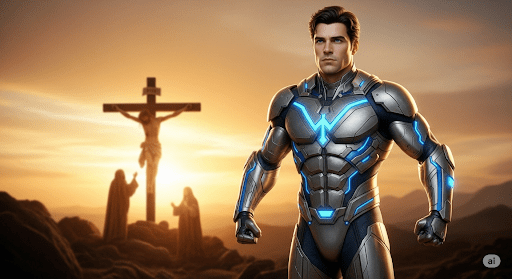
I’m a child of the sixties and early seventies. I grew up during that time of classic comic books and super heroes. Some of my favorites were the Fantastic Four, Spiderman, Batman and Superman. I am sure I’ve seen every episode of the Batman TV series with Adam West and I wanted to be Ben Grimm, The Thing, of the Fantastic Four. Perhaps the most telling evidence of how much influence these characters shaped my childhood is that they were often the subject of my childhood dreams. I can still remember dreaming one night of flying like Superman. My dream of flying seems to have been spurred by actually falling out of my bed because I awoke from the dream rather suddenly when I hit the floor next to my bed. While I may have had unrealistic dreams of super powers and saving the world, I know we all desperately need a hero. Believe it or not, this passage is all about that very idea.
Last week, we looked at the first thirteen verses of this chapter and talked about how we, you and I, are a part of the problem. We contribute to the sin, brokenness and evil that plagues our society. We talked about how the systems that make up our world are broken and subject to corruption because they are made up of broken people. It is not easy for us to admit it, but it is true. In 1910, one of the daily London newspapers posed a question to some of the great thinkers and philosophers of the day. They asked, “What is wrong with the world?” In a very terse response, G.K. Chesterton wrote back: “Dear Sirs, I am. Then he signed it, “Yours truly, G.K. Chesterton”. Chesterton’s pointed response was not just self-deprecation. His point was that while all of us are a part of the problem, I can only do something about me.
But acknowledging the true root of a problem doesn’t resolve the problem. When it comes to sin, pride, selfishness and many other character flaws, we might acknowledge their role and existence but we are totally at their mercy. We are simply unable to eradicate them from our lives. Eventually, every Bedford Falls will become Pottersville. (For those who don’t know that reference, go watch the Christmas movie classic “It’s a Wonderful Life”.) You might think I’m just a skeptic and pessimist. In some ways, you are right. I prefer to think of myself as a realist. We need a hero because we are unable to defeat the evil that exists in our world because, like Chesterton said, I am the problem.
But that introduces another dilemma and it is often the subject of many of those comic books I used to read. Human heroes with super human capabilities often contribute to the problem as much or maybe more than they fix the problem. This goes back to my earlier assertion that the issue is a systemic problem because it plagues every human. Now that’s not really a problem for comic books authors and publishers because that means the stories can keep flowing. If we are systemically broke and our heroes are also broken, then they never run out of potential stories. The problem never goes away. Perhaps that’s why the Superman writers had to introduce Kryptonite into the story line. If he was morally perfect, no character flaws or physical weaknesses then nothing could defeat him then the story line would get boring pretty quickly – stop, insert kryptonite.
No, this isn’t a sermon on comic books and super human heroes. But I am hopeful you will be able to see the relevance as we study this week’s focal passage. Last week was all about the problem, this week we are introduced to the solution. I have included the last two verses from last week’s passage to help tie these thoughts together. Sin is real, we see it on very hand and in every corner or our society. That sin has separated us from our God: “For our transgressions have multiplied before You, and our sins testify against us. For our transgressions are with us, and we know our iniquities: transgression and deception against the LORD, turning away from following our God, speaking oppression and revolt, conceiving and uttering lying words from the heart.”
If we stop there, we are left without any hope. That’s the hopeless situation we find in this passage until verse 14-15: “Justice is turned back, and righteousness stands far off. For truth has stumbled in the public square, and honesty cannot enter. Truth is missing, and whoever turns from evil is plundered. The LORD saw that there was no justice, and He was offended.” The basic principles that make it possible for us to live together in community – justice, righteousness and truth – are missing. We know we need them but we are the very ones who push them away, cause them to stumble or deny them entrance into our shared lives.
A super hero with character flaws. Who wants someone with super powers and broken character? Not me. I suspect you wouldn’t want that, either. In that situation, hope is nowhere to be found. In fact, things get worse. You might wonder where I came up with this analogy. Listen to the next verse, “He saw that there was no man — He was amazed that there was no one interceding; so His own arm brought salvation, and His own righteousness supported Him.” God saw that no man was stepping up and setting things right. At first, it sounds like God is surprised that nobody is doing anything about the situation. I believe that is just Isaiah’s way of emphasizing the fact that we can’t do anything about the situation and we need God to step up and take the lead. We may want to be our own hero, setting things right, but we simply don’t have the ability to fix the situation.
We actually see this happen quite often. We have politicians and leaders who step up with grandiose dreams of fixing the problems in our world. But an ordinary man can’t fix this mess because, as we’ve already seen, he’s part of the problem. We don’t need another ordinary man, we need an extraordinary one. We need someone whose origin is outside of the system, who’s not part of the problem. So, Isaiah tells us that God takes extraordinary measures and “His own arm” brings the salvation we need. We can’t fix this mess so God takes action.
I don’t know if you’ll remember, but last week’s focal passage starts out: “Indeed, the LORD’s arm is not too short to save, and His ear is not too deaf to hear. But your iniquities have built barriers between you and your God, and your sins have made Him hide His face from you to that He does not listen.” We know we need His help, but we resist Him. We know we can’t fix this, but we keep trying. Somehow, our sin builds up these walls between us and God and we resist His help. We have eyes, but we refuse to see. We have ears, but we refuse to listen. Sound familiar?
Hear Isaiah’s description of God’s intervention: “…so His own arm brought salvation, and His own righteousness supported Him. He put on righteousness like a breastplate, and a helmet of salvation on His head; He put on garments of vengeance for clothing, and He wrapped Himself in zeal as in a cloak.” God is getting dressed for battle and He is going to bring the salvation we desperately need. As He prepares Himself to intervene, we need to pay attention to the details because they matter.
This chapter started with the clarifying statement that God’s arm was not too short to save us. Now Isaiah tells us, God was “amazed” that nobody else was interceding. The reference to being amazed (v. 16a) is not intended for us to think that God was caught off guard and truly astonished that “no man” was capable of interceding. His astonishment is about our misunderstanding of the situation and how we continually look for someone, some human hero, to deliver us. In fact, this misunderstanding is precisely how most Jewish rabbis read and understand the Isaiah “servant” songs. They don’t see them as God coming to rescue us, but that He would use Israel to rescue herself. They see themselves, collectively, as the suffering servant and God will achieve His salvation of mankind through their own suffering. They have ears but they don’t hear and eyes but don’t see.
So, His “own arm” will bring salvation. God knows that the solution to the human condition is beyond us and our abilities so He must step in and rescue us Himself. Just to be clear, this is NOT a new plan because God “was amazed” and just realized this about His people. No, this has been His plan all along! God begins to “dress” for the battle of redemption and we need to pay close attention to the details. First, He puts on righteousness like a breastplate and a helmet of salvation on His head. The reference to God clothing Himself and putting on armor is an anthropomorphism (a way of illustrating something we cannot completely understand about God stated in a human way we can understand). When God steps up to take on the battle against our sin then He dresses Himself in the armor of righteousness and salvation.
God goes to battle against the heinous evil of this world and mankind wearing His righteousness and His love of and desire for man’s salvation as His armor. You might need to let that sink in a bit. We tend to be a bit hard headed in these things. What is needed to set us free from the evil and sin that plagues our lives and our world is only defeated by the righteousness, eternal love and will of God. Sin is NOT defeated in our lives by our own goodness or by the goodness of some human hero, it is only defeated by what God has done to redeem us. Now, pay attention! Sin CANNOT and will NOT be defeated in our world by any other means except the righteousness, eternal love and the will of our God.
(Note: these verses (Is. 59:16-17) are clearly the source for Paul’s reference in Ephesians 6 for the “full armor of God” that we must be willing to wear. It is also extremely important for Christians to recognize that the armor Paul references is not of our own making or skill. When we “put on the full armor of God” then it is armor He provides and enables us to wear. It is His righteousness, His salvation, His truth, His Word, His Spirit and His Gospel that enables us to do battle against evil.)
Next, He puts on garments of vengeance and wraps Himself in a cloak of zeal. Yes, God clothing Himself in vengeance and zeal are ominous thoughts. But God takes our sin and the evil it produces in our world very seriously and it must be dealt with decisively. But why vengeance and zeal? God’s vengeance is an appropriate response to the destruction sin has upon God’s good creation. Since it is so deeply entrenched within us, He must respond zealously against it. God is not bent on destroying us, but on destroying the sin that destroys us and the goodness God created. His work of salvation is, first and foremost, a work of redemption in us. His intent is to set us free from the destructive grip that sin has upon us.
However, it is important to note that those who refuse God’s efforts to save them does result in the zealous protection of His people and His creation. Isaiah states it this way: “So He will repay according to their deeds: fury to His enemies, retribution to His foes, and He will repay the coastlands. They will fear the name of Yahweh in the west and His glory in the east; for He will come like a rushing stream driven by the wind of the LORD.” But He responds to the repentant: “The Redeemer will come to Zion, and to those in Jacob who turn from transgression.”
Really, we would expect nothing less of a true hero. We need our hero Redeemer to be righteous, just, honest and true – the very things we are missing. We would expect Him to be zealous in dealing with the evil that destroys our world. We need Him to flood our land with His goodness and wash away the evil that oppresses the right way of living and the justice we long for. When that happens, we will fear His name and proclaim His glory from the east to the west and reaching to the farthest coasts. He is coming to Zion, the city and people of God; to those who turn in repentance from their sin. Not those of Israel by birth, but those of Israel by faith – a second birth (see Jn. 3:3).
Finally, listen to the covenant He makes: “‘My Spirit who is on you, and My words that I have put in your mouth, will not depart from your mouth, or from the mouth of your children, or from the mouth of your children’s children, from now on and forever,’ says the LORD.” There is a permanency to His covenantal promise. The extent of the redemption that God provides is not dependent upon us, it is dependent upon Him. His Spirit comes upon us at redemption and it never leaves us. His words are put in our mouths and they do not depart from us. The Apostles see this promise fulfilled in their own lives and they cling to it as their eternal hope. God’s Spirit within us is the down payment of this promise and Christ’s first coming and the fulfillment of it will be realized at Christ’s second coming.
This is the confidence and the hope we have in Christ. If our salvation was the result of our own efforts, we would always worry that it was insufficient. But because our redemption is the result of Christ’s work and His righteousness then our salvation is eternally secure in what God has done on our behalf.
We could never achieve this on our own, we are too broken and sinful. When we finally realize this – when our eyes are opened and our ears hear the truth of the Gospel by the Holy Spirit – then we see our glorious Hero, God in human form, for who He truly is. We fear and glorify Him at the same time. He is awesome, fearful, holy, righteous and majestic all at the same time. He should incite fear and worship from us at the same time. It would be like the image of the comic book Superman without his kryptonite weakness – unequaled strength and power but with a heart of humility and love. That, my friends, is our Jesus. He’s no longer just the figment of man’s hopes and dreams. He is the embodiment of the just, holy, powerful and loving God of all creation.
“May you be strengthened with all power, according to His glorious might, for all endurance and patience, with joy giving thanks to the Father, who has enabled you to share in the saints’ inheritance in the light. He has rescued us from the domain of darkness and transferred us into the kingdom of the Son He loves. We have redemption, the forgiveness of sins, in Him [Jesus]. He is the image of the invisible God, the firstborn over all creation. For everything was created by Him, in heaven and on earth, the visible and the invisible, whether thrones or dominions or rulers or authorities — all things have been created through Him and for Him. He is before all things, and by Him all things hold together. He is also the head of the body, the church; He is the beginning, the firstborn from the dead, so that He might come to have first place in everything. For God was pleased to have all His fullness dwell in Him, and through Him to reconcile everything to Himself by making peace through the blood of His cross — whether things on earth or things in heaven.” (Colossians 1:11-20 HCSB)
So, trust the fulfillment of God’s covenantal promise. God made the promise and He’s able to see it through to completion. “I am sure of this, that He who started a good work in you will carry it on to completion until the day of Christ Jesus.” (Philippians 1:6 HCSB) Our only hope for a hero is one who is able to come from outside of our broken humanity and rescue us. This hero is not a figment of our imagination, He is the embodiment of everything we need and everything we aren’t capable of being for ourselves. He is God’s perfect Son. He is the perfect, unbroken and sinless image of the invisible God. He has brought redemption to those who will “turn from transgression” and turn to God for salvation.
Will you do something about the problems in our world and let Him be your Hero?
 Hilltop Baptist Church - Shawnee, OK
Leave a comment