
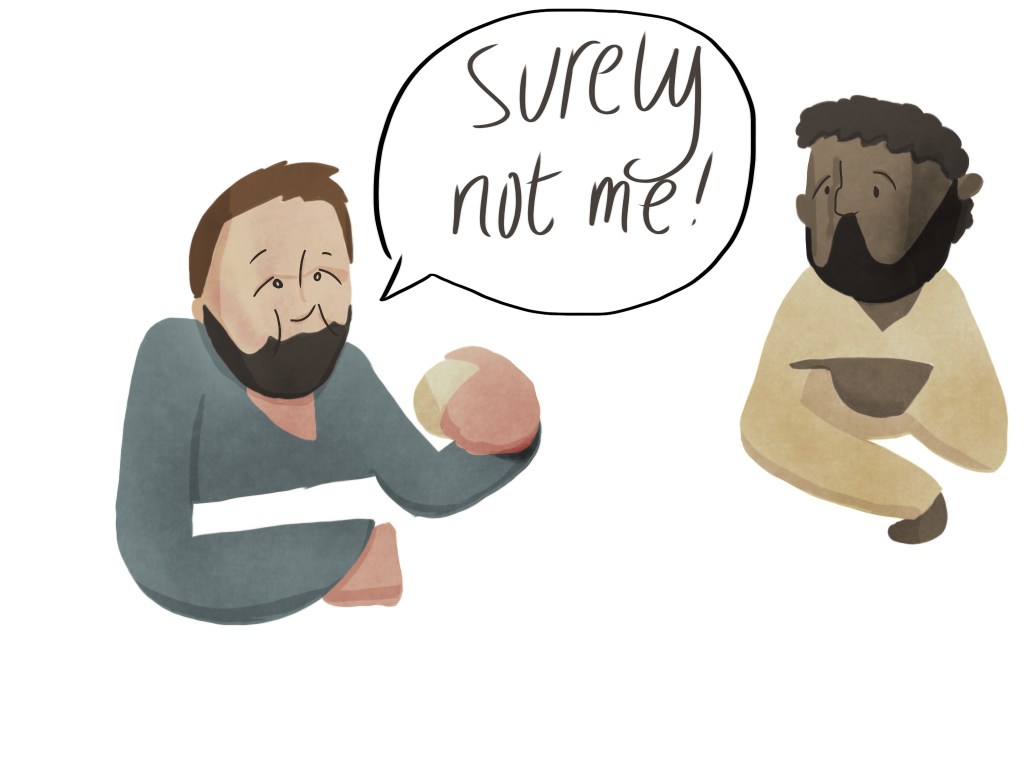
“When evening came, He arrived with the Twelve. While they were reclining and eating, Jesus said, “I assure you: One of you will betray Me — one who is eating with Me!” They began to be distressed and to say to Him one by one, “Surely not I?” He said to them, “It is one of the Twelve — the one who is dipping bread with Me in the bowl. For the Son of Man will go just as it is written about Him, but woe to that man by whom the Son of Man is betrayed! It would have been better for that man if he had not been born.” (Mark 14:17-21 HCSB)
I’ve always been a fan of mysteries and spy novels. In fact, I even decided to read the Ian Fleming books that are used as the basis of the James Bond movie franchise. As they say, the book is often better than the movie. To be honest, I just enjoy reading a good book. Don’t you? The scenes that play in my head as I read are always better than anything the film maker can conjure up or the actors portray on screen.
Everything about a good film is designed to elicit an emotional response from the viewer. A writer must do this only with the words he places on the page, but a film producer is able to use all kinds of tools to affect our mood and to drive us towards the emotional response he/she seeks to elicit from the audience. Lighting, set staging, props and music are very effective tools and are often used to set the mood for the scene. But these tools are only effective when the actor’s actions, words and mood reflect the same thing.
As I read this week’s focal passage, the idea of Judas’ betrayal is looming large and is affecting my personal mood. I know how this turns out, but the thought of Judas’ betrayal causes me sadness and emotional weariness. We’ve known this moment was coming for Mark told us very early on (Mark 3:19) that Judas would be the one to “hand over” or betray Jesus to the authorities. The tension between Jesus and the religious leadership has been deepening and can no longer be ignored or contained. It is going to erupt into a response from them towards Him and it won’t be pretty.
As we delve into this dark chapter of the story of the “light of the world”, we might do well to talk a bit about the role that emotions, mood and our feelings play in all of this. Now, I must tell you that we Baptists tend to try and divorce our emotions and feelings from all of this. At least, that’s been my experience over the past sixty plus years of involvement in Baptist life. Don’t misunderstand me, we know emotions play a big role in our lives, but we tend to try and keep them subdued and “under control” when it comes to faith. However, human emotions are an integral part of who we are and, as such, they must figure into what we know to be true and how we respond to Jesus and this thing we call faith. Emotions can’t rule us, but they can and should impact and influence us. To withhold and emotional response to things of faith is to deny an essential part of who we are and how God made us.
I said all of that because our focal passage is a very emotionally charged story and it would be wrong to just strip it down and dissect it in a harsh, cold and emotionally sterile environment. Mark intends to engage us on an emotional level and to pull us into this looming question: “Surely, not I?”
Let me begin by simply acknowledging and confessing, I tend to approach these types of settings with my emotions handcuffed and gagged. I want to gather facts and information and then evaluate them devoid of any emotional ties before reaching a well-reasoned conclusion. Nothing wrong with that approach if I was just a police investigator, right? Police investigators try to push their emotions aside so that their deductions, decisions and judgments aren’t tainted by their feelings or emotional ties to the case. But our emotions motivate us, move us, drive us to seek the truth and desire justice.
But I’m not a police investigator, I’m a pastor and I care about people, and I desire the best for them. I want to see their “whole self” living in a state of redemption. That’s the idea of “shalom” or godly peace and wholeness. God wants to engage us on all levels: spiritually, emotionally, intellectually and physically. “Jesus answered: Listen, Israel! The Lord our God, the Lord is One. Love the Lord your God with all your heart, with all your soul, with all your mind, and with all your strength. “The second is: Love your neighbor as yourself. There is no other command greater than these.” (Mark 12:28-33 HCSB)
Notice, the SHEMA states that the LORD our God is one and that we are to love Him as one unified person, with all of our heart, soul, mind and strength. It implies that God loves us like that, and we are to love Him in the same way – as a complete, unified, whole person. Now we tend to think of this in the sense that God meant for us to love Him with all of our being – and that is absolutely true. But it also means that we are to love Him with each part of who we are. We are not a body with a soul, spirit and mind (logic). We are a complete and unified person, and we are to love God in that way. Body, soul, spirit and mind all coming together in a unified love for and obedience to the LORD our God. Let me show you what I mean from our focal passage story…
Evening came and Jesus and the Twelve arrived at the location prepared for the Passover celebration. Jesus has been teaching the disciples what it means to live and work together. To have a singularity of purpose with varied skill, personality and mindset. As they recline and share the meal and remember God’s plans and purpose through the Passover, Jesus tells them that they are not united in purpose. They are not one with God in heart, soul, mind and strength. “One of you will betray Me – one who is eating with Me!”
To say Jesus’ words are emotionally charged would be a huge understatement. They seem to be pulsing with energy and emotion. They are gathered to eat a meal that is intended and designed to remind them of God’s purpose and His plan of redemption as He tells them: “One of you will hand Me over (betray) – one of you who is eating with Me!” Someone is not totally in, sold out to God’s purpose: heart, soul, mind and strength. It’s almost like His words are charged up with lightning – crackling with divine energy and judgment. Watch out! Something is about to happen. Someone is set to explode!
Mark then tells us, “They began to be distressed and to ask Him, one by one: “Surely, not I?”
Distress is one of those emotions I mentioned above that we tend to try and disguise and tightly control. Don’t let them see you sweat, right? I rarely lose my cool. When I do get upset, I tend to shut down emotionally and relationally. I withdraw from social interaction mostly as a means of keeping my emotions under control. Once, while I was with family going to have a weekend lunch, I received a phone call from a work colleague. He was upset and was making some emotionally charged accusations towards me. I lost my cool and began to respond verbally to him in a very loud voice. My oldest granddaughter was sitting in the back seat and had never seen me react in such a way. She was shocked and frightened. I quickly realized what I had done and ended the conversation. I then apologized to her and asked her to forgive my outburst. Later, I apologized to my work colleague. What was the issue? The distress caused by the accusations. Surely, not I?
Accusations are distressing and may cause us to erupt like an emotional volcano or even shutdown emotionally and deny all responsibility and culpability in the situation. Here’s the deal, Jesus doesn’t identify the person who will betray Him. He could because He knows who will do so, yet He doesn’t. For me, that’s the most interesting and intriguing part of this story. It is also the most enlightening when it comes to how we should hear, respond and relate to this story. Each of them pulled Him aside, one by one, and asked Him the same question: “Surely, not I?”
Let that question sink in a bit. Surely, not I? You would think that they would be fully aware of whether they personally had intentions of betraying Him. Yet, they each ask Him that question. Here’s why I think this is important and is really the focus of the story, in some way didn’t each of them betray Him? Judas may be the one who goes to the religious leadership and plots to “hand Him over” to them, but each of the disciples will betray Him over the next few hours. I think that’s His point. Judas might be the one who is noted for his betrayal (and should be) but each of them will be guilty of betraying Him. Each of them will fail to love Him with all of their heart, soul, mind and strength in the hours and days ahead.
Is He wanting them to wrestle with this emotional distress, in the moment, to confront their own tendencies to betray their love for God and, thus, for Him? Is He causing them to ask themselves the question, “Will I be the one to betray Him?” Is it I? Forcing them to do a bit of soul searching in their relationship with God. Why would God want to put us in distress? Why would He want to cause us to ask the question, “Surely, not I?”
We don’t like that idea, do we? God putting us in a situation that would cause mental or emotional distress. Yet, that is exactly what we find in this story. Jesus puts the disciples in a situation where He could name the one who would betray Him, but He doesn’t. He allows them to wrestle with the distress the unidentified offender causes and the questions his actions will raise. Why would He do that? Perhaps it’s because we tend to avoid those emotions and the hard questions they elicit. Perhaps because He wants them to delve into the distress that betrayal causes and the issues and emotions it will raise in their own lives. Surely, not I?
Each of us is guilty of the same, aren’t we? If love of God with all of our heart, soul, mind and body is the greatest thing He asks of us, then what happens when we fall so miserably short of it? What happens when we find ourselves wrestling with these questions? When we recognize ourselves as His betrayer?
Oh, you think not?
He tells them, “It is one of the Twelve – the one who is dipping bread with Me in the bowl.” Well, that narrows it down. Doesn’t it? Not really. Unless Jesus said these words just as He and Judas were dipping bread into the bowl, this statement would have applied to each of them. Again, I suspect He is intentionally making this broad and vague. Forcing them to ask themselves that very question, “Surely, not I?”
Have you dipped your hand with His in the bowl? I have and I’ve struggled with this question. In what ways have I failed Him, betrayed Him, walked away from Him, denied Him and doubted Him? It is far too easy to look at the disciples’ failures and to criticize, blame and fail to see ourselves in their actions. It is far too easy to avoid the distress of the question, “Surely, not I?” But it is far more enlightening to plunge headlong into the question, wrestle it to the ground, pin it under your forearm and stare into the darkness of its eyes and honestly ask the question, “Is it I”?
Finally, we get to Jesus’ statement: “For the Son of Man will go just as it is written about Him, but woe to that man by whom the Son of Man is betrayed! It would have been better for that man if he had not been born.” Let’s deal with each of these issues in turn…
First, the Son of Man is clearly a reference to the figure in Daniel 7, 8 and 9 who “was given authority to rule, and glory, and a kingdom; so that those of every people, nation, and language should serve Him. His dominion is an everlasting dominion that will not pass away, and His kingdom is one that will not be destroyed. (Dan. 7:14)” The Son of Man in Daniel is opposed but the Ancient of Days arrives, and judgment is given in favor of the holy ones of the Most High. In other words, the Son of Man (Most High) will appear to lose the battle, but the Ancient of Days will see to it that He and His holy ones ultimately triumph.
This is precisely what the crucifixion, death and burial of Jesus seems to be. A catastrophic loss and Satan appears to have won the battle, but God isn’t finished. More on this in later sessions but suffice it to say that Jesus didn’t lose this battle. It happened just as it is written about Him. He is given authority to rule, and glory, and a kingdom; so that those of every people, nation, and language should serve Him.”
Lastly, Jesus gives a dire warning regarding the betrayal: “It would have been better for that man if he had not been born.” Nobody wants to hear those words spoken about himself. That’s the purpose of a warning, there’s still time to change your mind. God knew what Judas would choose, but Judas’ choice was his own and he is responsible and accountable for that choice. Foreknowledge of an event is not cause of said event. While God knew what choice Judas would make, God did not cause Judas to make that choice. God is not responsible for Judas’ sin, Judas is. God is not responsible for your sin, you are.
Are we guilty of betrayal? We are if we understand properly the first and greatest commandment, loving God more than anyone or anything else in life. Would it have been better if we had not been born? Only if, like Judas, we are guilty of a betrayal that is unaccompanied with repentance. You see, that’s the difference between what Judas did and what the other disciples did. Judas did not repent, he died unrepentant. The real question is not about what Judas did but what he failed to do. You face the same issue. Will you recognize your betrayal, like Simon Peter and the other disciples, and turn away from it towards Jesus and seek forgiveness or will you fall headlong into it unwilling to repent and turn away?
Heart, soul, mind and strength. We need to engage our entire person in seeking, knowing, serving and obeying God. Truth is meaningless without obedience and knowledge is hollow and lifeless without the emotion that sparks a fire to burn deep within us. Jesus drew His disciples into the distress that question of betrayal brings in order to prepare them to deal with their own acts of rebellion, failure, faithlessness and betrayal and the feelings that accompany them. Like them, we can either languish in our own betrayal or we can experience His forgiveness as we turn in repentance towards Him and confess our failures. Which will you pursue? Denial or deliverance?
Surely, not I?
 Hilltop Baptist Church - Shawnee, OK
Leave a comment